With BärGPT, a new AI assistant for the Berlin state administration will launch on 25 November 2025, developed by CityLAB Berlin in close cooperation with the Senate Chancellery. The goal: to support administrative staff in their daily work with smart AI features and to make routine tasks more efficient.
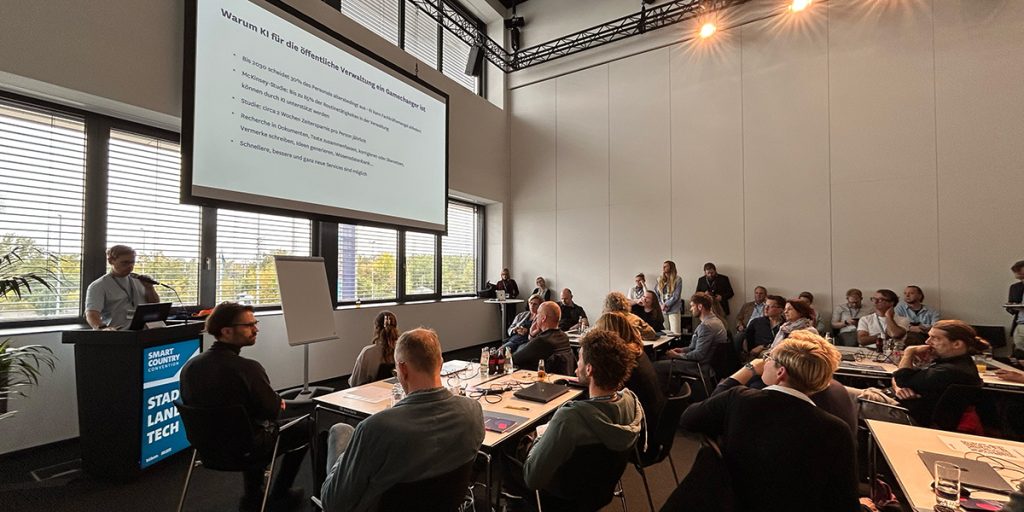
The challenge is well known: by 2030, around 30 percent of employees in the Berlin administration are expected to retire. The resulting shortage of skilled workers puts significant pressure on existing structures. At the same time, studies show that up to 85 percent of routine administrative tasks can be handled more efficiently with artificial intelligence.
AI has long since found its way into everyday work – this is also reflected in a survey we conducted as part of our workshops with the Berlin administration. In response to the (non-representative) question “How do you use AI at work: very secretly, very officially, or not at all?”, “very secretly” came out clearly on top. The interest and the need are there, but so far, an official, data-protection-compliant solution has been missing. This is exactly where BärGPT comes in: as a GDPR-compliant service that administrative staff can use officially – without legal grey areas and without additional costs.



An AI assistant developed with and for the Berlin administration
In spring 2024, the Berlin Senate Chancellery set up a cross-departmental task force to explore the potential use cases for responsible AI in public administration. In regular workshops with CityLAB Berlin, needs were identified and initial ideas sketched out. The key result: the Berlin administration needs a sovereign and user-friendly environment to test AI in a safe and practice-oriented way.
BärGPT emerged from this insight – a proprietary development by CityLAB Berlin instead of an off-the-shelf product. The reasons for this approach are manifold: in-house development makes it possible to address the specific needs of the Berlin administration while also building internal AI expertise. In an agile development process, initial prototypes were created together with administrative staff, tested, and continuously improved. The result is a software that not only works technically but actually helps in day-to-day work.
A standout feature is the so-called “administrative knowledge”: a curated collection of the most relevant documents of the Berlin administration, such as the Joint Rules of Procedure (Gemeinsame Geschäftsordnung, GGO I). These frequently needed documents are available directly in the chat to all employees and do not have to be uploaded individually. This feature was developed deliberately on the basis of user tests and turns BärGPT into a genuine administrative tool, not just a generic chatbot.
What can BärGPT do?
BärGPT can be integrated as an AI assistant into many phases of the working day. It helps to structure information, to create and improve texts, and to analyse and summarise documents. Responsibility for the content, however, always remains with the employees of the State of Berlin. BärGPT supports their work but cannot replace professional experience and expertise.
The development of BärGPT was accompanied by extensive user testing. BärGPT focuses on the features that received the highest ratings in these tests. At its core is a free-form chat, similar to commercial offerings such as ChatGPT or Claude. Users can formulate their own prompts – depending on the task and need. The main use cases are:
- Writing, correcting, translating and summarising texts
- Using it as a research tool and for answering general questions
- Quick access to previous conversations via a chat history

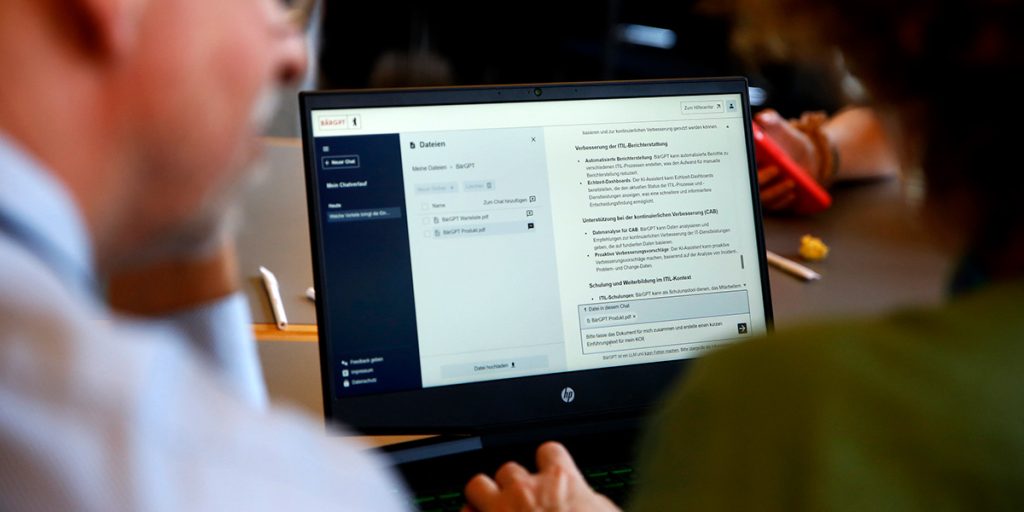
BärGPT becomes particularly powerful in combination with its document management. With just a few clicks, documents can be uploaded, automatically analysed and prepared for AI-supported search using an embedding model. The so-called RAG search (Retrieval-Augmented Generation) makes it possible to search several documents or entire folders at the same time. The language model’s answers are supplemented with source references, ensuring traceability.
Another practical feature: BärGPT supports import and export of the most important file formats – text, PDF, Word (.docx) and Excel. In particular, export to Word format is a unique selling point compared to many similar services and was integrated at the explicit request of test users.
Data sovereignty and open source
CityLAB Berlin works under the motto “Public Money, Public Code”. Accordingly, BärGPT is open source and available on GitHub. This is not only for transparency reasons, but also because we have found that products improve through public feedback. The open-source development also makes BärGPT easier to reuse for other public administrations and institutions.
BärGPT’s database infrastructure is operated by a BSI-certified cloud provider with servers located in Germany and meets the highest standards of data protection and GDPR compliance. The language model used is Mistral 3.2 Small – a powerful model provided by the French AI company Mistral AI. The decision not to use a locally hosted model was a conscious one: model development is progressing at great speed, and operating our own hardware locally would not only be costly but also significantly less performant than accessing the model via API. Crucially, no data is used for training purposes.
The option of running BärGPT on state-owned infrastructure was examined in depth during development but turned out to be (for now) not feasible, primarily for technical reasons. A modern AI system like BärGPT requires a contemporary cloud infrastructure that offers our development team automated deployments, CI/CD pipelines and interfaces to external services. These conditions are currently not available in the Berlin state network (“Berliner Landesnetz”). However, the new cloud strategy of the State of Berlin provides a clear perspective here, which we will continue to pursue. We are already in constructive exchange on this with our colleagues at ITDZ.
Data protection: where do we stand, where are we heading?
Using personal data with BärGPT is fundamentally unproblematic, since no data is passed on to the language model for training purposes. At the same time, the framework is being created to enable the legally compliant use of artificial intelligence in the Berlin administration: the Berlin E-Government Act will be amended to include a legal basis for processing personal data in AI systems. This provision is expected to enter into force at the beginning of 2026.
What’s next?
BärGPT is a living product. This means it is continuously developed further based on the needs and feedback of its users. Already planned or in prototype testing are:
- Integration of MCP servers, for example to use information from the Open Data Portal or written parliamentary questions (Parla)
- Online web search for up-to-date information
- Storage and management of favourite prompts
- Group management for shared documents
We look forward to further developing BärGPT together with the Berlin administration and are excited to hear feedback from real-world use. Feedback is always welcome – it is the only way to create a tool that truly helps.
From 25 November 2025, BärGPT can be used free of charge by all employees of the Berlin administration. Registration is simple at www.baergpt.berlin. Further help and tutorials are available in the Help Centre.
Further reading:
Anyone interested in the technical details and background of the development will find a more in-depth technical article from our development team here.