In this column, we provide monthly insights into the daily work of our “Smart City & Administrative Innovation” team. The team—comprising project managers, service designers, UX/UI designers, and smart city designers—brings a wide range of perspectives to working with public administration to move Berlin forward. Balancing long-term strategy and agile solutions, they share their experiences and lessons learned from CityLAB.
I’ve worked at CityLAB for over five years as a service designer and public service coach for innovation and digitalization projects in the administration and across the city. In both roles, I deal with so-called “wicked problems”—problems that are multi-causal and have effects on many levels. That’s the case in almost all projects in the field of digital urban development.
- The cause is often not directly visible or clearly defined
- Many different actors are involved
- Various needs must be balanced
- The solution is part of a system
- There are many interdependencies that are not always obvious
This brings with it a special set of requirements for my role as a designer and coach. In addition to empathy, curiosity, and analytical thinking, one key skill is having no fear of complexity—and the ability to approach problems systematically and co-creatively.
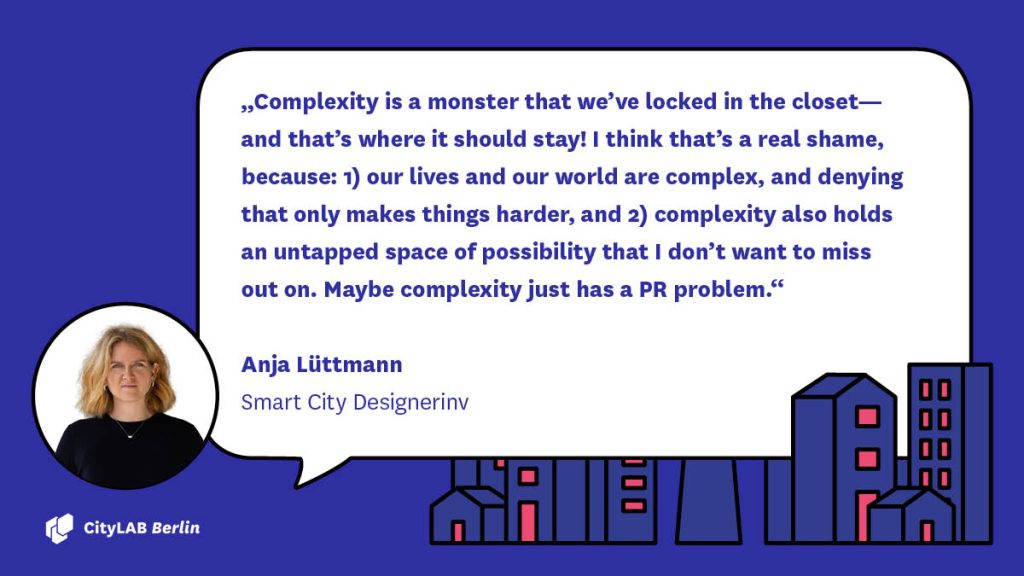
Sometimes I ask ChatGPT for help with a complex issue, and it says: “I’ll help you bring order.” That’s comforting. Because when dealing with complexity, we often try to organize, reduce, or ideally resolve it. But we don’t like complexity—we’d rather not have to deal with it. It’s like a monster we’ve locked in a cupboard. That’s a pity, because: (1) our lives and the world are complex, and ignoring that only creates more problems, and (2) complexity contains untapped potential that I wouldn’t want to miss out on. Complexity just has a PR problem. So what opportunities lie within it? And how can we shape complexity so that working with it feels easy and even fun? Before I give you my survival tips as a service designer, let me first tell you what I’ve learned from watching films.
Why Season Finales Always Disappoint Me – or the End of Tension Through Resolution
I love good stories—reading them or watching them. I’m especially fascinated by science fiction. It’s both an escape from everyday life and a source of inspiration for philosophical reflection. What I don’t like is the moment when a season finale arrives (which it inevitably does), and the resolution doesn’t meet my expectations. At that point, I often lose interest in the rest of the series—until a new plot twist comes along and my imagination is sparked again. No matter how well-written the resolution is, it never quite matches what I had imagined. It can’t. The complexity of the story suddenly becomes flat and predictable. Only afterward do I realize why I was so captivated: the abstraction, the unresolved tension. That’s what made it exciting. Once it’s resolved, the magic fades. That imaginative space is exactly what good stories need in order to fascinate me.
Seeing Complexity as an Opportunity and Designing It Consciously
Let’s go back to the intimidating complexity I face in my everyday work. I’d like to reframe this misunderstood “monster”: as a fantastic, immaterial space where everything is possible, and all potential solutions coexist. Doesn’t that sound more inviting? Could it be that complexity—as a space full of possibilities—is actually an essential part of any creative process? Something we should welcome? Who’s afraid of a little more tension when designing our reality?
What Opportunities Are Embedded?
When we use complexity as a design element and process driver, it creates opportunities for innovation, adaptability, and meaningful engagement. Instead of simplifying everything, we can use complexity to design solutions that are richer, more resilient, and more human-centered.
The design thinking process uses the double diamond model, which was popularised by the British Design Council in 2005, to find innovative solutions to complex problems. The model consists of phases of divergent and convergent thinking. Generating many ideas (divergence) opens up a space of possibilities, which is then closed again by narrowing down to the best solutions (convergence). Complexity is thus deliberately used as an opportunity in the process, leading to more creative and effective results.
| Phases | Sub-Phases | Methods | Information |
| Problem Phase | Discover | User-centered analyses and investigation | Consolidate and focus |
| Problem Phase | Define | Gains and pains, touchpoints and user context, problem analysis, reframing | Consolidate and focus |
| Stage | Define concrete problem | Point of View / Problem Statement | Decision |
| Solution Phase | Develop and design | Methods for idea development | Collect and expand |
| Solution Phase | Implement | Methods for prototype development | Consolidate and focus |
- Better framing and wider solution space: Recognizing complexity early (e.g. by clarifying context and variation) helps avoid premature oversimplification and opens up new opportunities.
- Human-centeredness and inclusion: Complexity invites us to involve diverse stakeholders, align different interests, and foster collaboration—key for successful, user-focused projects.
- Richer design: Complexity helps create more nuanced and engaging outcomes. It enhances understanding and can provide deeper insights throughout the design process.
- Innovation and adaptability: Complexity theory teaches us to abstract (reduce to essentials), adapt (respond to changes), and self-organize (develop order without top-down control). These mindsets are useful not only for designers but for anyone involved in shaping cities and driving digital transformation.
Like a good wine, complexity can be a mark of quality. It adds richness and depth—making things more interesting and complete. It doesn’t have to be scary. It can actually be enjoyable.
Making Complexity Appealing – or: How to Design with Ease
Here are two examples from my work that show how complexity can feel good—and foster empathy, holistic thinking, and curiosity.
Mapping and systems thinking with participants:
To simplify and digitalize complex administrative processes, I often use user journey mapping. Co-creating the user journey helps identify workflows, pain points, and areas for improvement. But more than that: when different departments come together, participants develop empathy and mutual understanding. People see they are not alone, and that others face similar challenges. A sense of shared purpose emerges. Everyone is in the same boat.
Using uncertainty as creative fuel:
In complex systems, linear planning often fails due to unpredictable external factors. But we don’t want to close our eyes—we want to use uncertainty as fuel for innovation. The “Future Wheel” method helps: you identify a desired change or goal, map its direct and indirect effects, and prioritize them. In doing so, uncertainty becomes less intimidating. It opens the door to new ideas. In workshops where we’ve used this tool, I’ve seen participants actually start to enjoy thinking about the unknown. That optimism boosts motivation and helps projects move forward, even when things get tough.
These methods show how to “invite” complexity. They belong to the divergent phase of the design process, where the goal is to open up the space of possibilities. If you’d like to become a “complexity designer” yourself, start with low-stakes or fictional examples. Build confidence and have fun exploring complexity. For example: imagine aliens land on Earth in 150 years (a nod to one of my favorite sci-fi books). So we’ve come full circle—back to my love for science fiction. And with that, I wish you more complexity (and excitement) in your project work.