In this column, once a month, we provide insights into the everyday work of our team “Smart City and Administrative Innovation”. The team of project managers, service designers, UX/UI designers and smart-city designers brings together diverse perspectives in the collaboration with the administration, in order to advance Berlin together. With a balance of long-term strategies and agile solutions they share their experiences and insights from CityLAB.
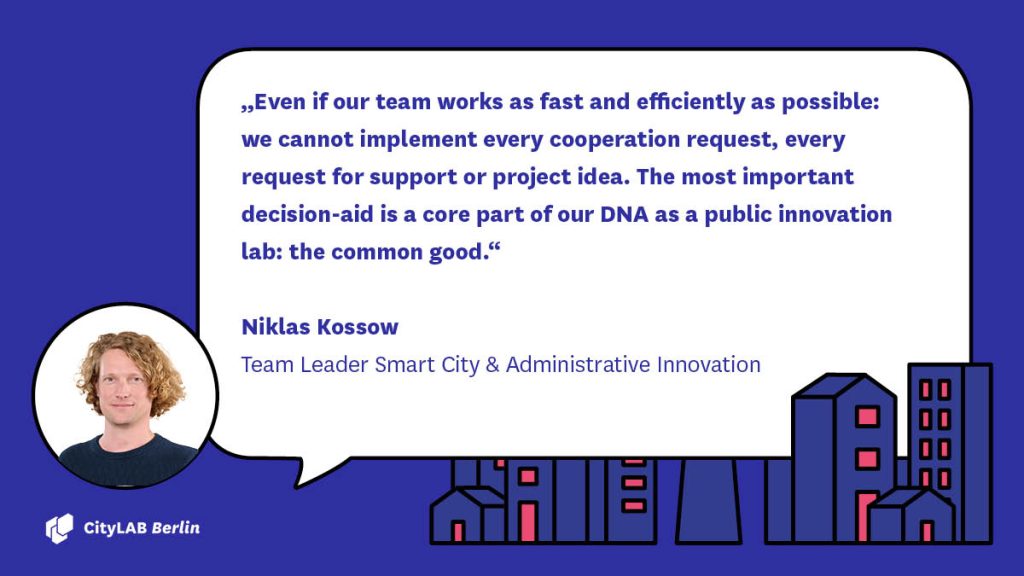
For many of us it isn’t easy – and there are many self-help books on how we can learn this better: saying “no”, setting boundaries, focusing on what really matters. That applies not only in private life, but often in professional life as well. In my time at CityLAB I too had to learn it again and again, because our capacities are also limited. Even if our team works as fast and efficiently as possible: we cannot implement every cooperation request, every request for support or project idea. The most important decision-aid is a core part of our DNA as a public innovation lab: the common good.
Orienting Towards the Common Good as a Target
CityLAB Berlin is a project of the Technologiestiftung Berlin, supported by the Berlin Senate Chancellery. This sentence — in our case also known as the funding notice — every employee of CityLAB learns very early on — as I did when I started working in the lab five years ago. When you take a closer look at this sentence, there’s quite a lot in it: CityLAB is run by the Technologiestiftung (Technology Foundation), i.e., a foundation which by its statute is committed to pursuing non-profit purposes and promoting innovative technologies. CityLAB Berlin is supported (not commissioned) by the Senate Chancellery — which means it should implement projects that benefit as many Berliners as possible. From this it follows that with our work we serve the common good of our city and thus how innovation and digitisation can benefit all Berliners.
What Does That Mean in Practice?
This is a strong claim, but for us it is decisive in all our projects and has a strong influence on how we implement them. If our team, for example, develops a proposal for a new project, or receives an idea from someone in our network, we not only examine whether our team has the skills and capacities to implement it, but also how large the potential added value for Berlin is. If we notice that a project will only reach a small group or that the desired impact is far too difficult to achieve, then we decline the project — even if we would find it exciting to work on it. In doing so, many an idea has been filtered out by our value-effort matrix. This also means that we terminate projects like Stadtpuls when we realise they are being little used — or continue to develop products like Gieß den Kiez even after years, because they reach many people and continue to inspire.
The Common Good in Collaboration
In cooperation with partners from the administration, orientation towards the common good for us means always seeking a solution together. Sometimes ideas arise where we realise they are not purposeful or not in the interest of the target group. In these cases we also address this with the project partners. But don’t worry: In almost every request we find a way to help — with a tip how it might be done differently, by connecting someone with an organisation that can support better, or with someone who has already solved a similar problem. Instead of immediately developing a prototype, we first look more closely at the processes, organise workshops to learn more about a particular challenge and try to bring a new perspective. Often that already helps and saves unnecessary work.
User-centredness is always the focus of our work. Many of our projects begin with research into the target user group of a product — whether it’s Berliners at home, or employees working with the administration’s devices. We want to understand how people use digital products. Occasionally we even spend a few days in the Bürgeramt to get in contact with the staff and the clients on site. In the interests of the common good we test our way through digital products so that they must be procured in a fitting way and the Berlin administration does not realise after purchase that they actually wanted something completely different. In all of these examples the big word common good always plays a role.
Public Money, Public Good
Recently I was allowed to moderate a panel with our colleagues from Kultur B Digital on sharing digital infrastructure. Holger Plinckert from Wikimedia Germany reminded us, with the amusing principle ÖGÖG – Public Money, Public Good – that public-funded infrastructure should also be made publicly available. In the sense of the common good we live this principle also with regard to our offerings and the knowledge we produce. That is why we use formats such as this blog and our podcast to give regular insights into our work. By the same principle — public money, public code — all our digital products are accordingly open source. Likewise, our methods and insights are publicly accessible in our knowledge repository. Through this we also become a public innovation lab, because we do our best to work openly and transparently and to share the results of our work with the public and to use them in the interests of the common good.
What Does That Have to Do with Saying No?
And yes, I already wrote: I too had to learn, in my five years, to say no. No to projects for which we have no capacity, no to ideas that cannot be realised, and no to measures that do not serve the common good. Because at CityLAB, after all, we work with public money. That means we sometimes refuse collaboration even to our favourite partners and friends in the Berlin administration — when we realise that a project is too elaborate or has no potential to deliver common-good-oriented results. Then for us it either means: Let’s try it differently — or simply “no, we’re not in on that.” For me, this focus on the common good is an important reason why I’ve been so happy working at CityLAB for five years now and why we have such a fantastic team, motivatedly working on Berlin’s digital future.