When it comes to the digitalisation of public administration, the journey certainly isn’t always straightforward. Rather than discovering quick shortcuts, one often encounters complex signs or stumbles upon surprising desire paths. Creating orientation points is an important step forward – but it’s even better when people embark on the journey together.
The Senate Department for Science, Health and Care (SenWGP) has established an important framework with its internal exchange format “Digital Tag”(Digital Day) to bring interested employees together for exactly this purpose. Various formats offer opportunities to learn about project developments and current digitalisation topics and to engage in conversation. We were there at the end of January and would like to give you some insight into the format and its evolution.
A Programme with Both Broad Perspective and Detail
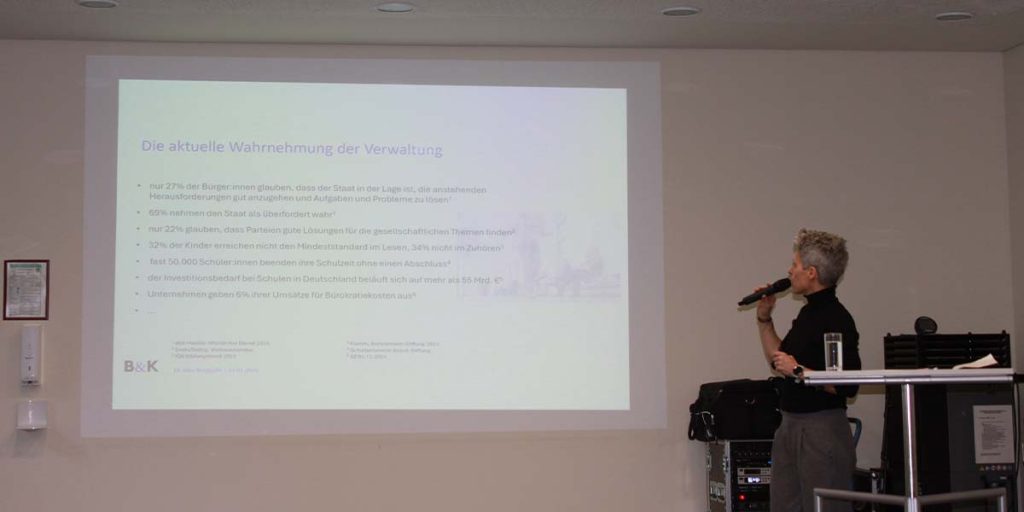
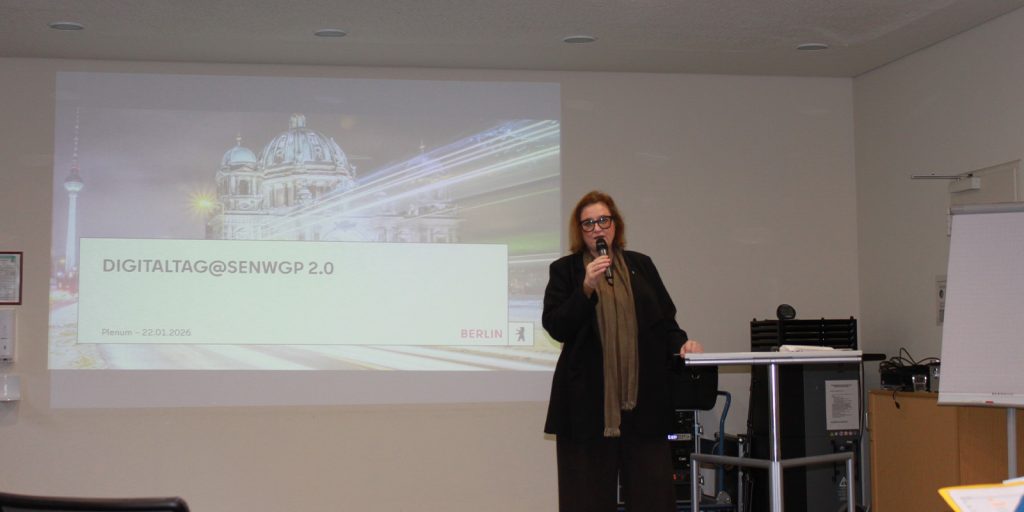
After a welcome by the Senator for Science, Health and Care, Dr Ina Czyborra, “Digital Tag” began with an opening keynote by Dr Julia Borggräfe on organisational development, raising key questions. What structures are necessary for project work in administration to really work well and be attractive? And how can leadership help foster digital transformation? These and similar questions invited participants to reflect deeply on their own ways of working.
Large projects such as the roll-out of the electronic file (E-Akte) and the BerlinPC were then in the spotlight. The respective project teams provided insights into goals, schedules and training offers and shared experiences from the process so far. There were also various workshops and presentations on topics such as the use of generative AI, the digitalisation of public health services, and tips & tricks for efficient AI prompting.
Within the framework of “Digital Tag”, the Data Hub Berlin initiative of the Senate Chancellery was also presented. Data Hub Berlin provides the Berlin administration with new opportunities for working with data — from storage and processing to visualisation. Michel Maier-Bode (Berlin Senate Chancellery) and Klemens Maget (CityLAB, Public Data Team) presented the project status and gave insights into the first use cases prototypically implemented with the Berlin administration.
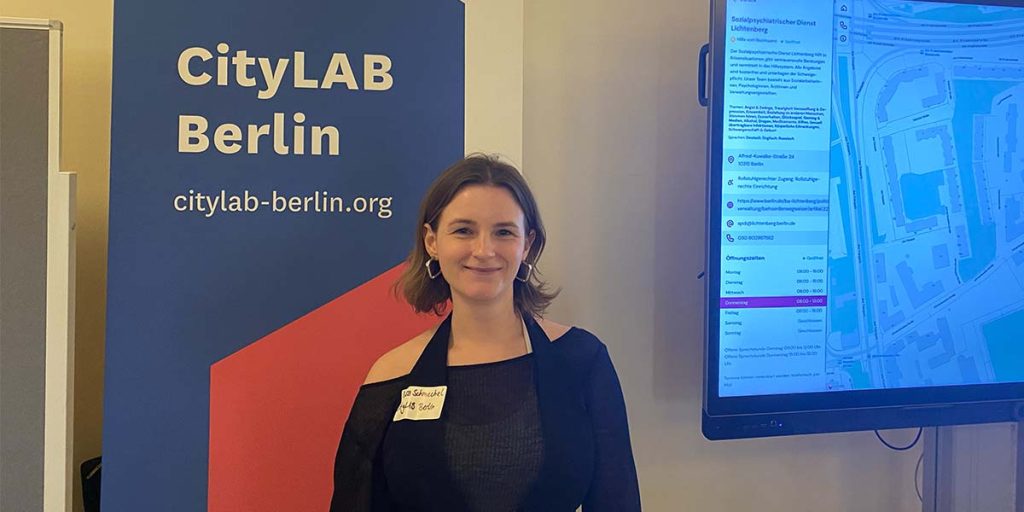
In addition to the main programme, there was a small exhibition in the entrance area featuring internal and external projects. CityLAB was present with a booth to provide information about the Data Hub, BärGPT and other projects.
Creating Spaces for Dialogue
This year’s “Digital Tag” organised by SenWGP took place for the second time, following a successful premiere in March 2025. What makes it special is that it emerged as a joint bottom-up initiative of various departments. In the initial planning meetings, the focus was on identifying employees’ information needs and interesting topics. CityLAB was also part of these discussions as the city of Berlin’s innovation lab and took part in the first “Digital Tag” with an impulse on prototyping and a workshop on remote work.
A frequently asked question is how good conditions can be created so that employees are able to participate in exchange formats. Do they have enough time? Do they receive support from their supervisors? Especially for voluntary offerings, the level of engagement and motivation of the employees themselves is crucial. This challenge is not unique to administration — other organisations face similar issues.
“Digital Tag” is a great example of how a concrete and impactful initiative can arise through identifying employee needs and overcoming organisational silos. The format has developed not only in terms of content but also structurally, incorporating even more external impulses. As CityLAB, we are pleased to support such initiatives and continue the journey together, because we are convinced that digital transformation is much more than technology. It’s about putting people at the centre to make sustainable change.
–
The Senate Department for Science, Health and Care organises and promotes digital projects to inform people in the city about helpful services and offerings.
Examples include:
- Hilf-Mir.Berlin, developed in cooperation with CityLAB Berlin, offering an overview of psychosocial support services: https://www.hilf-mir.berlin
- Digitaler Lotse, an offering of the Specialist Office for Caregivers funded by SenWGP, providing caregivers with a guide to the support system: https://www.angehoerigenpflege.berlin/digitaler-lotse