How can we reduce people’s fear of (digital) application forms? How can interactions between applicants and caseworkers be improved? And how can service design methods help optimize the application process for basic income support as a particularly sensitive social benefit?
Understanding Basic Income Support
Basic income support is meant to do exactly what its name suggests: secure the essentials of life. For those who depend on it, having access to this form of social assistance is crucial. In reality, however, only a fraction of eligible individuals submit an application. One reason is the extensive and complex application process applicants must go through. To ensure that as many eligible people as possible can apply quickly, it is essential to place a strong focus on user-friendliness when digitizing the application. We support the Senate Department for Labour, Social Affairs, Equality, Integration, Diversity and Anti-Discrimination (SenASGIVA) in this effort using methodological approaches. Here’s how we do it.
Exploration Phase
The first step is the exploration phase, where the goal is to understand the type of benefit being applied for: Which legal requirements must be met, and which organizations are involved?
Basic income support (under SGB XII) is a form of social assistance specifically intended for people of retirement age or those with a permanent reduction in earning capacity. It ensures a basic livelihood for people who are no longer able to participate in the labour market — covering housing, food, and other daily necessities. Many recipients rely on it due to their pension being insufficient. Like most social benefits, it is only granted upon application. In this case, a new application must be submitted every twelve months to continue receiving support. In Berlin, more than 90 percent of these applications are processed by social welfare offices.
The second step focuses on the target group: Who are the people who typically apply for basic income support? What are their current living situations? In Berlin, around 97,000 people received this benefit last year. The target group mainly consists of people of retirement age; around three quarters have German citizenship, and a similar amount are single households. Based on this information, we can form initial assumptions about the needs of applicants.
However, the statistics on recipients do not tell the full story. Studies suggest that the target group is significantly larger. It is estimated that only about 60 percent of eligible individuals actually submit an application. To better understand the remaining group, direct engagement is necessary.
Taking a Closer Look at the Application Form
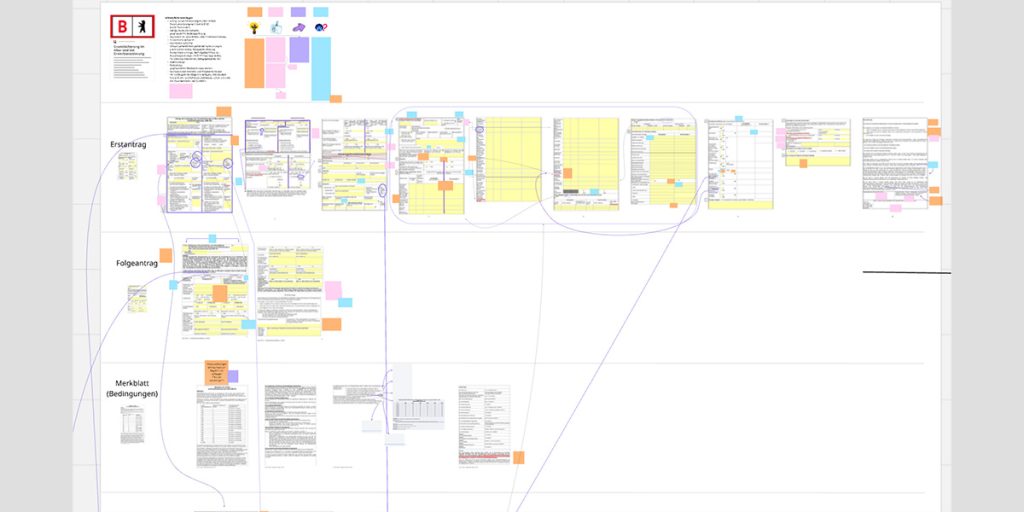
The third step in the research process is to closely examine the application form itself. For many people, the first encounter with such a form is associated with negative emotions. However, when viewed through the lens of a well-intentioned “document improver,” it can also be highly inspiring. We ask questions such as:
What is the overall structure, and which elements are easy or difficult to understand?
What information do applicants need to have ready, and which documents are required?
How are different sections of the application and its attachments connected?
We document all insights and ideas, as well as required documents, dependencies between different sections, and any remaining uncertainties.
Observing and Understanding
Up to this point, we have formed many assumptions — for example, that certain parts of the application are easy to understand while others are not, or that some sections frequently cause problems while others are trivial. To test these assumptions, we visit places where applications are actually completed and processed. This marks the beginning of the next phase: observation. Through so-called shadowing, we observe people as they work through the process. This allows us not only to validate our assumptions but also — and more importantly — to uncover things that often remain unspoken. Especially in routine tasks, many steps feel self-evident to those involved and are therefore not mentioned, even though these observations can be game-changers.
In-Depth Interviews with Users and Caseworkers
Alongside observations, we conduct interviews to complete the picture. These interviews help us question what we have observed and explore it in greater depth. Is what we observed plausible? Have we understood the motivations behind actions? Can we clearly identify pain points? In both observations and interviews, we aim to include as many diverse perspectives as possible — from both applicants and caseworkers. One challenge is establishing contact with applicants. To address this, we reach out to initiatives that support people in filling out such forms and are therefore in direct contact with potential applicants.
Visualizing the Application Process with a Service Blueprint
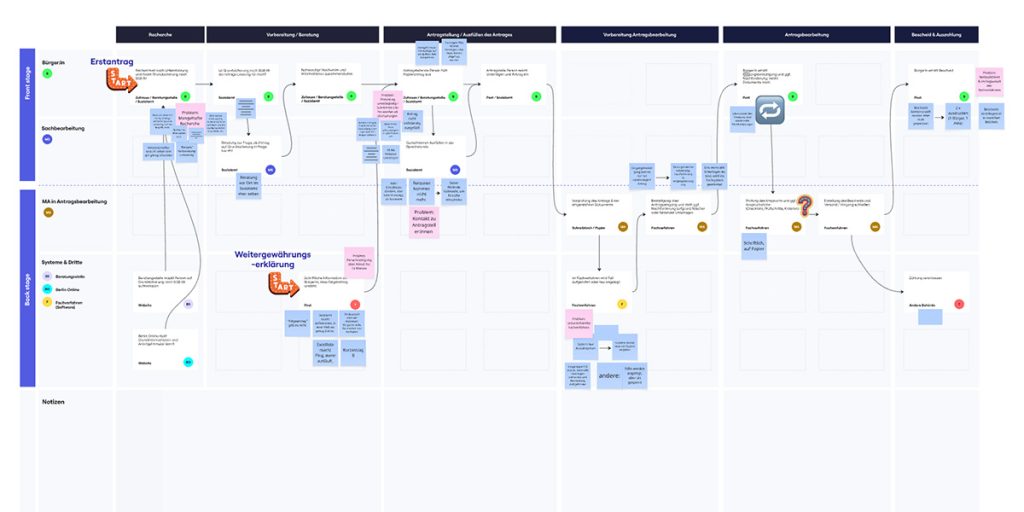
At the beginning of the exploration phase, we also created a service blueprint. This is a service design method and a visual tool used to map and analyze services in detail. It helps represent the entire service experience from both the applicant’s and the caseworker’s perspective: When does the process begin? What steps follow? When are background systems or third parties involved? The service blueprint answers these questions and provides an overview of the service “Application for basic income support in old age and in cases of reduced earning capacity (SGB XII).” Even the title of the application reveals initial opportunities for improvement — but more on that later. Another advantage is that, combined with our research, observations, and interviews, the blueprint enables us to better understand the overall process and clearly define roles and responsibilities.
What’s Next?
Once the research phase is complete, we move on to synthesizing our findings. Based on this, we collaboratively develop an initial prototype of an improved application form. This prototype allows us to test whether all identified user needs that emerged during the research phase have been adequately addressed. To find out how the project continues, stay tuned for our next blog post.