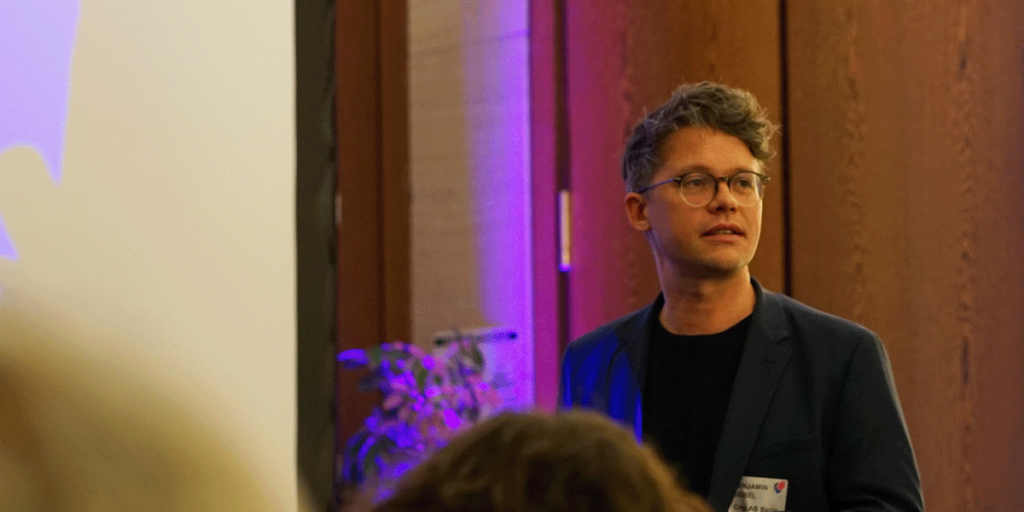
The new year is still young, but the list of projects and ideas is long: After an eventful 2025 at CityLAB, we are starting a year that offers just as many new opportunities with lots of new topics. In addition to the further development of BärGPT, these include the opportunity to set priorities in the Berlin House of Representatives election that will advance digitization and administrative modernization. Our CityLAB Director Dr. Benjamin Seibel naturally has a few ideas up his sleeve as well. Here, he gives five answers on how he views 2026 and what makes him optimistic.
What are you particularly excited about this year?
There is a lot of movement in administrative digitalization right now. The inertia of the past was a luxury we simply can no longer afford. This has to do with the global political situation, but also with disruptive technological developments. I now see much more willingness to overcome the previous petty squabbles and really break new ground. For us as an innovation unit, this is exciting because our work can have a much greater impact in such a situation. This also has consequences for our strategic orientation. As I wrote in the foreword to our 2025 annual review, we are now also tackling bigger issues. Experimentation is important, but ultimately it’s about sustainable impact and change.
In Berlin, a lot has been done recently to improve the framework conditions. First and foremost, of course, is administrative reform, but also simplifications in public procurement law, a cloud strategy, and an open source strategy. We must take advantage of these opportunities. Personally, I am very excited about further activities at the federal level, such as the future of the “Deutschland Stack.” I think the trend toward greater centralization is the right one, but ultimately it is important that states and municipalities are able to take advantage of these offerings in an uncomplicated manner. For our BärGPT project, for example, we can use the sovereign cloud infrastructure of GovTech Germany, which is a real relief.
For us at CityLAB, it’s shaping up to be a very busy year, with our roadmap already full in January. One networking highlight will definitely be our annual summer conference on June 3 at the Umweltforum in Berlin. We have just published the open call for contributions.
BärGPT is one of the success stories of 2025. What does 2026 hold in store?
We are overwhelmed by how well BärGPT has been received by the more than 10,000 users in the Berlin administration. I am also delighted for our team, which has really surpassed itself here. Nevertheless, the work continues—we have just rolled out a major update that implements a new language model and additional features. And the next updates are already in the planning stage. The connection of MCP servers, which will enable BärGPT to connect to other systems, such as our popular AI research tool Parla, should be particularly interesting. The initial experiments look very promising.
Berlin is electing a new House of Representatives this year. Which topics in the area of administrative modernization and digitization would you like to see given prominence?
The list is long, of course, even if the issues are complex in detail and therefore only suitable for election campaigns to a limited extent. It is clear that we need significantly more speed and agility throughout the entire IT lifecycle: it is simply no longer acceptable that years can pass between the initial request and the implementation of a productive solution in the administration. Especially since countless rounds of coordination do not necessarily lead to better results. We need to become much more pragmatic, streamline processes, and create more decision-making capacity.
I also consider the development of a comprehensive data infrastructure, the Berlin Data Hub, to be extremely important. This may sound cumbersome at first, but it is fundamental work to ensure that Berlin’s administration is fit for the future. Without a good data foundation, AI applications, for example, quickly reach their limits. However, modern data management requires not only technology but also qualified personnel and the right governance structures—which is, of course, a challenge in the current budgetary situation.
What makes you optimistic about this year—especially in light of current developments in AI?
The fact that we are now slowly approaching the “plateau of productivity” in the hype cycle. We are seeing the first real added value, but there is still much more to come. The combination of data management and AI could render most traditional IT procedures obsolete in the coming years. There has already been significant progress in AI-supported case processing, where processing times have been drastically reduced. Citizens can also expect things to become easier: soon, I may no longer have to fill out the application myself, but simply send an AI to work its way through the bureaucracy for me. Without giving too much away, we are working on it!
However, modern data management requires not only technology but also qualified personnel and the right governance structures—which is, of course, a challenge in the current budgetary situation.
What are your wishes for the CityLAB team?
That we maintain the positive energy, curiosity, and good team spirit that characterize our work. The conditions in the public sector can be challenging at times, especially when, like us, you are passionate about a good cause and want to make a difference. As part of the Technologiestiftung Berlin, we were able to build a powerful team in an ideal environment, close to the administration but also with the necessary freedom to prove its added value for the city. Now we need to consolidate this success story and develop a long-term perspective without losing the unique character of an innovation lab.
New here? Then get to know us better or book a time slot for our exhibition at Platz der Luftbrücke. We look forward to hearing from you!