In this column, we give you a monthly glimpse into the everyday work life of our “Smart City and Administrative Innovation” team. The team—made up of project managers, service designers, UX/UI designers, and smart city designers—brings a diverse range of perspectives to collaboration with city administration to move Berlin forward together. Balancing long-term strategies with agile solutions, they share their experiences and insights from CityLAB.
Great Encounters Start Before the First Handshake
“Gatherings don’t begin the moment people walk into the room. They begin the moment you decide to gather.”
Priya Parker
US author Priya Parker argues in The Art of Gathering that successful gatherings are never accidental—they require intentional design: with purpose, with meaning, with a sense of mission. Translated into the context of urban collaboration, it becomes clear that much of what is today called a “network” is in reality a loose series of routine meetings—devoid of shared purpose, friction, or meaningful impact.
Exchange Needs Design, Not Just Structure
At a time when administrations are digitizing, integrating systems, and consolidating competencies, the question of how we come together is more important than ever. The Initiative for a Capable State, in its recently published guidelines, emphasizes: transformation succeeds only when innovation is shared, knowledge is accessible, and administrations become capable of learning. But learning requires exchange—and exchange requires more than a network diagram in a PowerPoint presentation.
Stadtlabor2Go: Learning in Public Spaces
In Stadtlabor2Go, we didn’t deliver perfect answers—but we created spaces where new questions could emerge. Stadtlabor2Go is a CityLAB Berlin project experimenting with new forms of inter-municipal exchange—not in sterile conference rooms, but where the city is alive: in public spaces. The goal is to spark the creation of urban innovation labs in other municipalities—currently Wiesbaden and Mönchengladbach—and to develop formats for learning-oriented administrative gatherings.
Central to this approach is the question: Why do cities meet constantly—and yet learn so little from one another?
Encounters Create Relationships, Not Just Exchange
Stadtlabor2Go and many other CityLAB formats are a deliberate contrast to conventional network meetings. The aim: to bring administrations together on equal footing—not in hotel conference rooms, but in city spaces, parks, or even virtually. And what happens? When cities meet differently, they ask different questions, think further, and act in a more interconnected way. Exchange becomes relationship. And from relationships grows trust—the perhaps scarcest resource in inter-municipal collaboration.
Urban Diplomacy as a Strategic Necessity
Urban diplomacy – the strategic collaboration between cities across institutional, political, and cultural boundaries – is gaining increasing importance. Many of the challenges facing cities—from digitalization and climate adaptation to administrative modernization – can no longer be solved in isolation. They require shared learning processes, common infrastructures, and active exchange of experiences—both successes and failures. Urban diplomacy is not an “add-on,” but a prerequisite for a capable state: it builds trust where there is uncertainty – and commitment where responsibilities overlap.
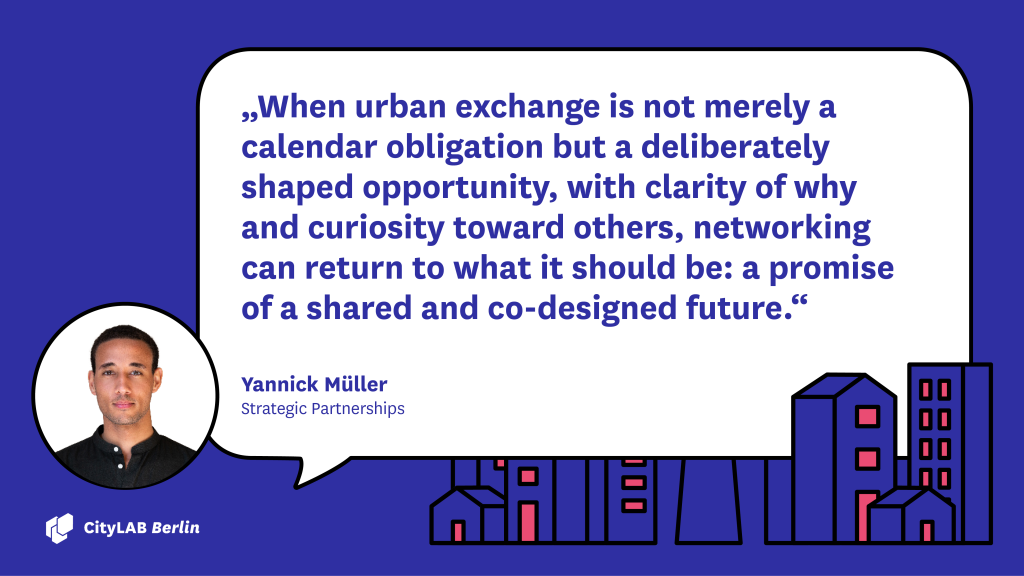
When urban exchange is not merely a calendar obligation but a deliberately shaped opportunity—with clarity of why and curiosity toward others—networking can return to what it should be: a promise of a shared—and co-designed—future.