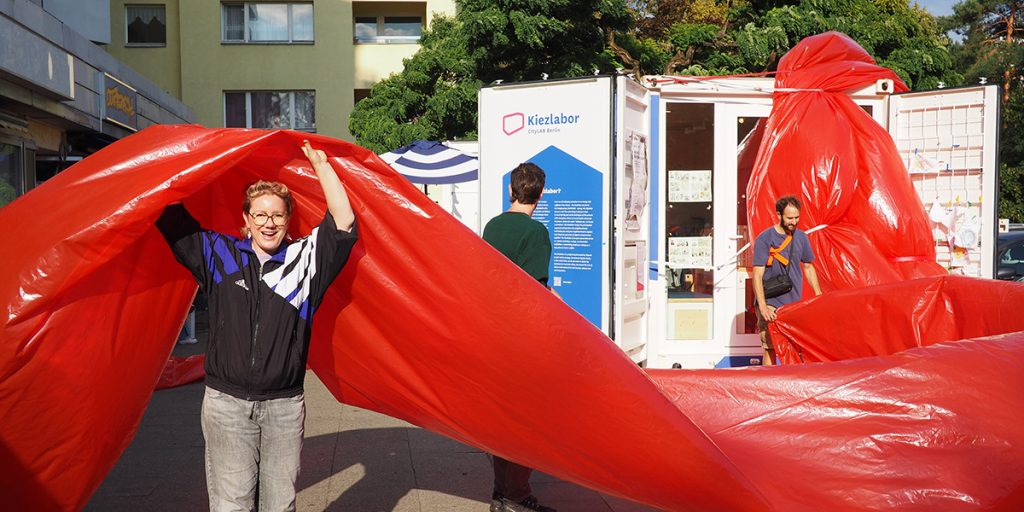
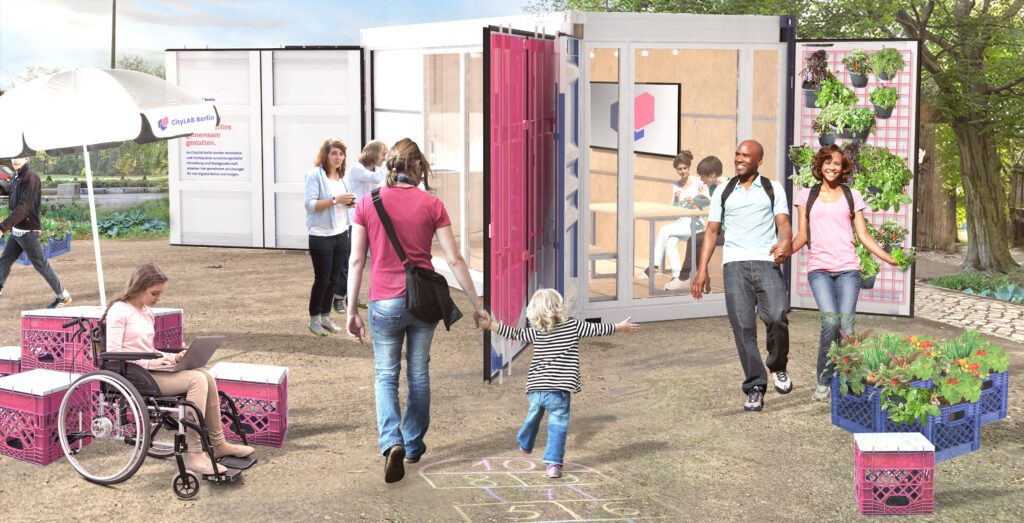
A blank sheet of paper is always a little intimidating. So many possibilities. But where do you start? How do you go about it? What if, in the end, it was all for nothing? That’s exactly how we felt in 2023 when CityLAB received the assignment from Senatskanzlei Berlin to implement the project Kiezlabor as a measure of the Smart City strategy Gemeinsam Digital: Berlin. For us, that blank sheet was an old shipping container – and the question was: How can we bring innovation and participation out of CityLAB and into Berlin’s neighborhoods?
From Blank Page to First Step
You have to start somewhere. So we turned to the Handbook of Public Design: assess the current state, identify stakeholders, sharpen the understanding of the problem, go outside and meet people – the classics of prototypical work. That’s how we do things at CityLAB.
For those who don’t know yet: “At CityLAB Berlin, innovation and participation are brought together: administration and urban society work jointly on solutions for the digital Berlin of tomorrow.”
The white container itself becomes a prototype – a blank sheet of paper used to design, explore, and test.
Other Cities, Similar Experiments – Inspiration for Our Mobile Urban Lab
In 2023, we were at the beginning of a wave with only a few others trying to figure out the purpose of a mobile urban lab. There was Tiny Rathaus Kiel, Karlsruhe had a mobile real-world lab at the research institute KIT, and one or two other cities were playing with similar ideas but not moving forward.
Next step: refine the understanding of the problem. What problem can a mobile lab in the neighborhood actually solve? That means having many conversations, doing lots of research, observing carefully. And what do you observe in Berlin in winter? No need to tell anyone: frustration, fatigue, distrust, a gray city, gray faces.
That may sound exaggerated, but the overall tone isn’t entirely wrong. For some time now, worrying tendencies in how we live together have been visible. This applies on a large scale – but also very locally, in the neighborhood. Where did the construction site outside my front door come from? Why can’t I get an appointment at the Bürgeramt? Or from the perspective of Berlin’s administration: Why do the same three people show up to every participation workshop in the district?
So we need a space where administration and residents can meet around neighborhood-relevant topics and work together – using new, inviting, and low-threshold methods – on the city of tomorrow. Something like a lab in the neighborhood. Hmm, what could we call that…
Kiezlabor – An Update for Urban Participation Processes
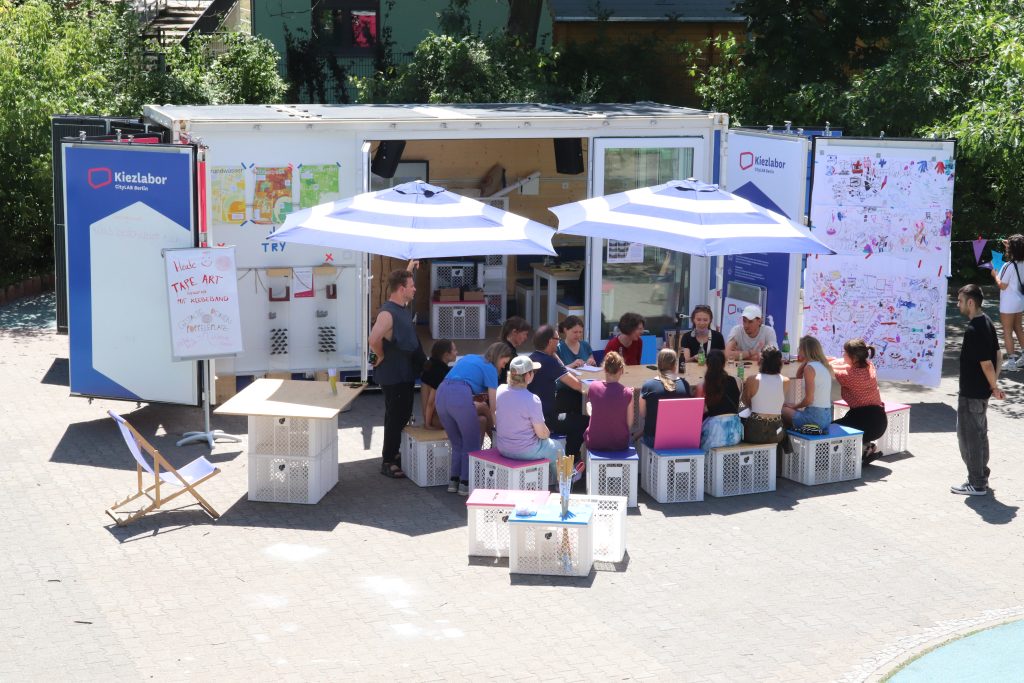
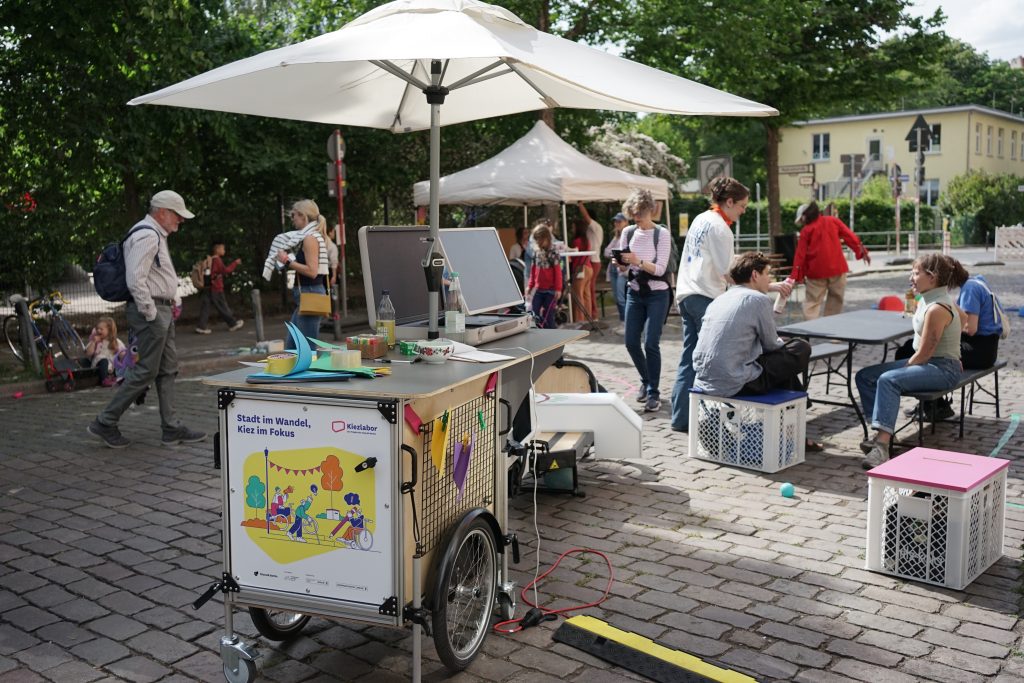
Over the past three years, we have created a space with Kiezlabor where co-production in public space comes to life. What does that look like? Here’s a small glimpse:
The Classic Conversation Starter: Appointments at the Bürgeramt
For most Berliners, the most common point of contact is probably the Bürgeramt – and at the same time the most legendary place in the city. Many people have made it through the doors of Berghain before ever setting foot in the Bürgeramt. Whether it’s the missing appointment, the missing ID photo, or the lack of motivation to travel to Spandau because that’s the only office with an available slot – there are many hurdles on the way to a new passport.
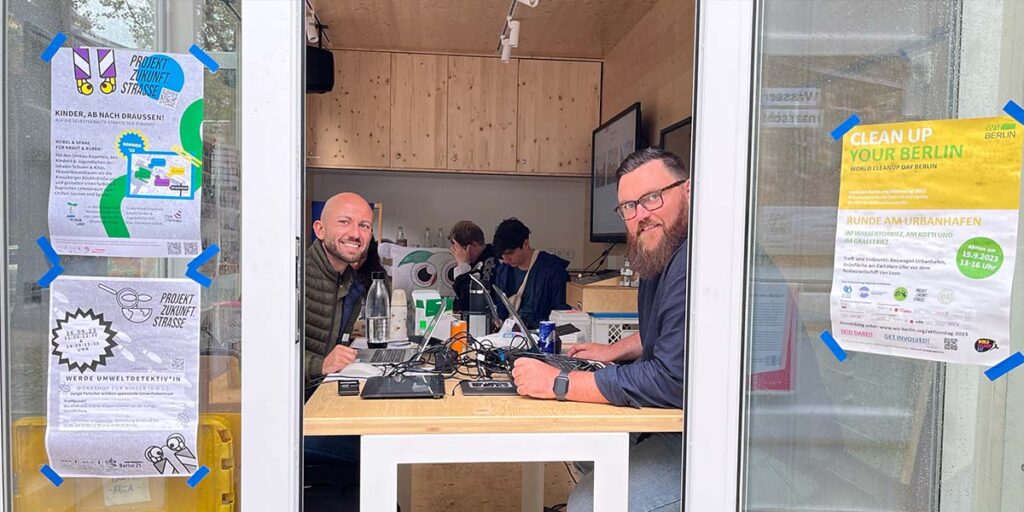
In a wonderful cooperation with Ausbildungsbürgeramt Friedrichshain-Kreuzberg, we turned this fundamental interface upside down in Kiezlabor. What if the Bürgeramt came to you? On your way to daycare or heading home from work, you suddenly see a (now colorful) container, a few tables in front of it, and a large banner: “New ID card? New passport? No appointment needed.” Most people were initially worried about identity theft before believing that this was actually real.
Anyone who has ever browsed the participation platform mein.berlin.de with some patience has certainly come across various hard-to-read urban plans. They say things like “Parcel 3,” underneath are lots of confusing lines – some dotted, some dashed, and, believe it or not, some even colorful. This is usually the point where people give up, close the browser tab, open Facebook instead, and post an angry comment about the new construction site in front of the daycare center.
Making Urban Visions Child’s Play with AI
What says more than a thousand confusing lines? Images, of course. With images and a pinch of magic in the form of AI, we’ve made participation processes literally child’s play.
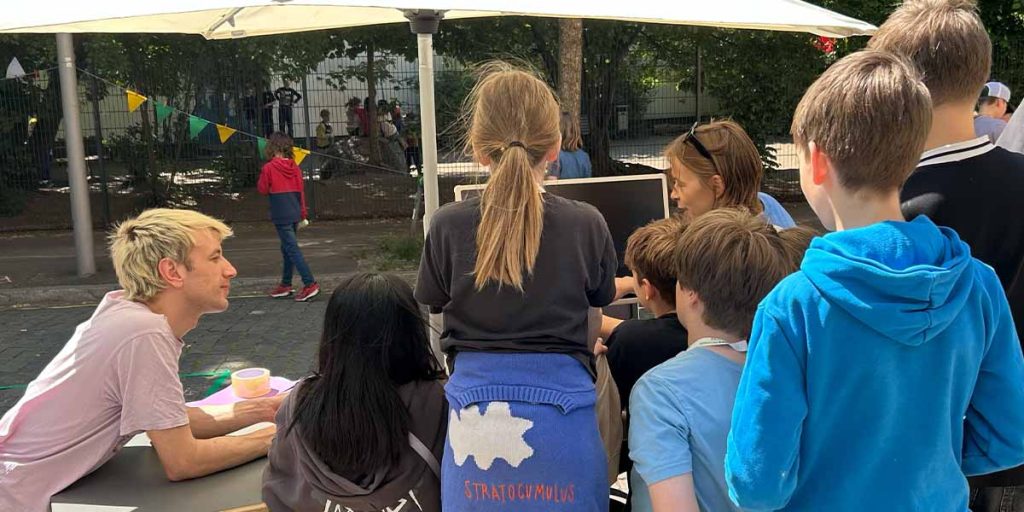
In Friedrichshain-Kreuzberg, a school class visited us again this year. We brought along our AI image-generation tool Stadtvisionen, a large monitor, and staff from the district office. We’re sitting on a street that is to be redesigned as a school zone. After a short introduction to the topic, the students’ wishes for such a zone, and a walk along the street, the principle is simple: point at it, call it out. A bench here, a badminton net there, a bike lane over there. At the same time, we feed these prompts into the AI and edit images of the actual street so that a bench, a badminton net, and a bike lane appear.
Sounds naive? Then you’re underestimating children. As soon as things become tangible, they can become remarkably critical. Then objections arise: “But if that’s there, you won’t be able to get through here anymore,” or “Who’s going to take care of the plants?” Of course, good moderation is needed. But when change becomes tangible through images, abstract planning turns into an organic process. Ideas, problems, and concerns come to the table that would never surface when looking at a plan – or only become obvious once the bike lane has already been built.
The world of participation keeps turning. One final example from Kiezlabor turns another classic of citizen participation on its head. Let’s assume a participation process runs relatively well. Residents have cast their votes, shared their concerns and wishes. In most cases, nothing happens for quite a while – and in many cases, those concerns and wishes disappear until eventually a first planning draft is presented, let alone a bench built somewhere out of sight. Worst case: people were given hope for change, and that hope was disappointed.
From Vision to Concrete Implementation
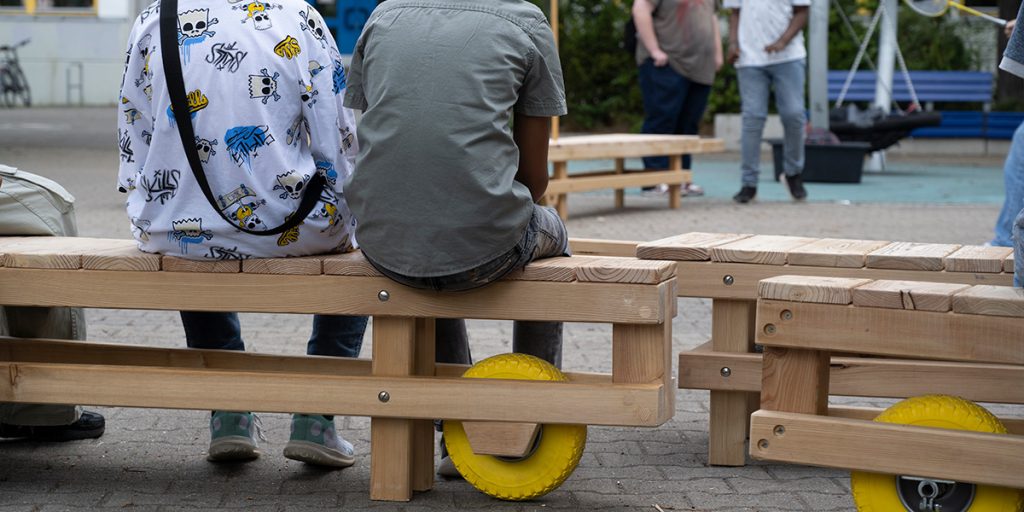
In many cases, it doesn’t have to be that complicated. Urban furniture in the right hands is not rocket science. And so Kiezlabor regularly transforms into a neighborhood workshop in no time. If it’s well prepared and the right people are involved in a preliminary process, a small square can be redesigned within six months, and the first pieces of urban furniture can be created together by a group of residents in the very first month.
The furniture is first designed together, then built together – needs-based, visible, usable. Planning and implementation move closer together. Trust does not arise from promises, but from lived experience in one’s own environment.
From Extra Work to Collaboration – From Participation to Cooperative Urban Development
In the coming years, such cooperative projects will become increasingly important. With the Climate Adaptation Act that emerged from the tree referendum, the city has set itself ambitious goals. That’s positive at first – but it also carries the well-known risk that politics focuses on ever-new targets while administration, lacking resources, becomes increasingly overwhelmed. On the other hand, the tree referendum also showed that Berliners have a strong interest in shaping their city and are willing to invest considerable time and energy in a livable neighborhood – provided they are offered an interface such as a referendum. Especially the scene around urban greenery and sustainability is extremely vibrant.
In recent years, particularly large model projects such as Haus der Statistik have shown how cooperative urban development can work. The upcoming task is to build structures in which collaboration between civil society and administration can take place in many smaller, local processes – and in which administration can also benefit from these processes.
Over the past years, we at Kiezlabor have gained extensive experience in what works, what fails, and why.
Currently, participation is often limited – partly due to uncertainty about how to conduct such processes – to setting up a page on mein.berlin.de and, at best, holding a participation workshop attended by the same three people.
Yet a well-moderated process can even save work and resources. Vienna offers a wonderful example with its Grätzllabore, which demonstrate an entire range of exemplary characteristics:
- 1) Contact persons and spaces directly in the neighborhood
- 2) Participatory, self-managed budgets
- 3) Organization for residents’ self-organization
- 4) Structural anchoring of exchange and consultation with district representatives via a steering group
The result is needs-based, often independent design of public space.
Berlin already has individual components of this concept scattered across the city – but the puzzle pieces have not yet been put together. For the realistic implementation of projects like the Climate Adaptation Act, such a structure is essential. The 2024 evaluation of Berlin’s citizen participation and its participation spaces points in a similar direction. It highlights the urgent need for a practical participation guide including a toolbox of methods – a handbook for recurring standard cases to enable administrations to implement cooperative urban development (psst, spoiler: we’re currently working on something).
It also emphasizes the importance of physical presence of administration on site. While a structure exists, district participation spaces are barely known because they themselves are not anchored in the neighborhoods. This is different, for example, with neighborhood management offices. They have offices on site and serve as local contacts. However, they exist only in structurally disadvantaged areas and will largely expire in 2027.
A way to better embed structures – Berlin needs neighborhood labs on site
We have enough spaces in our neighborhoods. Inner cities are experiencing increasing vacancies—including in Berlin. Important places for encounter and social exchange are disappearing, and at the same time a gap is opening up for a new concept.
These spaces offer tremendous room for experimentation. The town hall of the future could become visible here in the form of Kiezlabore. The individual components already exist: a mobile Bürgeramt visiting the neighborhood, a space for low-threshold participation in local urban development projects, occasionally even converted into a workshop. The example of Kreisler im Wutzky in Neukölln shows how a repair and lending shop can function in a vacant mall space.
And even more importantly: here, too, a prototypical approach is needed – no master plan, but needs-based experimentation. After all, almost everything is already there: a few vacant storefronts, a modular set of formats, and enthusiastic people in every district – that’s all it takes for now.