Shortage of skilled personnel, demographic change, and overdue bureaucratic reform: the pressure on public administration has reached a new high. It’s no wonder that the use of artificial intelligence quickly became a hopeful prospect. But it also became clear very quickly: AI and administration don’t mesh that easily after all. Too many sensitive data and privileged information, too few solutions tailored to the specific needs of administrations. Left behind was the feeling that AI might be the express train out of the bind—one that the administration ultimately fails to board. As an innovation driver and research institution, we at CityLAB have for some time been engaging with the potential of artificial intelligence. In exchange with administrative staff, two solutions in particular have emerged—ones that can significantly ease day‑to‑day administrative work: the Parla AI tool and the BärGPT AI assistant. Below, we explain how these applications support via AI, why administrations need tailored AI solutions, and what we’ve learned in their development.
When Routine Becomes Overwhelmingly Large
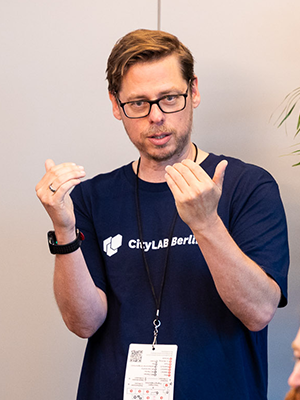
On one hand, there are thousands of similar requests to citizen services; on the other, opaque legal texts. Routine tasks dominate the workday of many administrative employees. This is exactly where many staff members ask for relief, as our user research shows: “Mentioned especially were writing, formulating, and shortening texts; translation into different languages—including simplified language; and use as a research tool, for example with Parla for responding to written citizen requests,” explains Ingo Hinterding, who leads the prototyping team at CityLAB. When developing prototypes, his team works hand in hand with administration staff, ensuring that each function responds to a concrete need. Anna Mehrländer, part of the team and Product Owner of the AI assistant BärGPT, recalls from the extensive user testing that employees especially need support in communication and knowledge documentation: “Concretely, potentials for AI were named in several areas: an intelligent inbox, automated document checking, use of text modules, efficient legal and norms research, as well as automated data processing, e.g. for cost estimations or geodata.” Beyond more efficient handling of routine tasks, sometimes it is in the role of advisor or decision aid where administrative staff hope AI can support.
Prototyping with the Administration: Parla and BärGPT as Learning Practice Examples
To respond to the flood of documents, data, and regulations, and to address often lacking digital knowledge management in administration, we released the Parla AI tool in early 2024. The prototype uses AI to read all responses to written requests and major committee matters (so‑called “red numbers”). When you ask Parla a question, the system formulates a suggested answer based on that textual basis and displays the documents used for it. “What particularly surprised us about Parla was how much the tool eases daily work: searching through over 15,000 written requests in a legislative period becomes much easier, and many told us that Parla helps relieve constrained personnel resources. For that, there was much thanks—but also constructive criticism,” reports Ingo on the user testing of Parla.
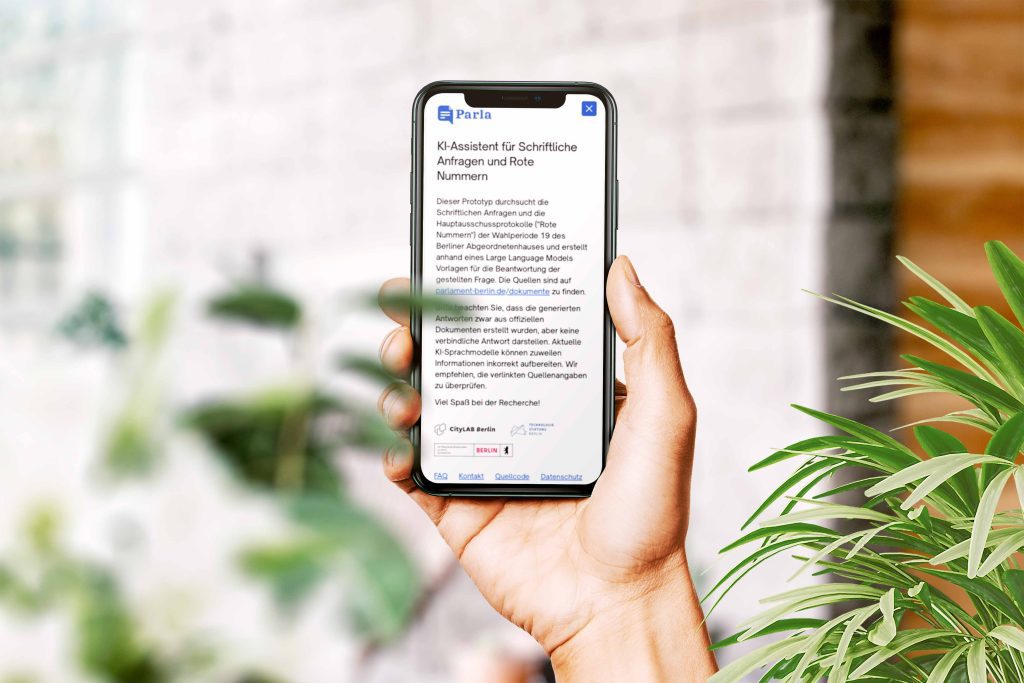
Parla can support not only parliamentary and administrative daily work digitally, but also provide many other actors—associations, chambers, media, civil society organizations—with an overview of current issues and resolutions. The tool quickly revealed real potentials for AI in administration during practical tests, so the idea arose to include additional sources in the search. But since the AI assistant in this application case was already functioning quite well, we chose to explore other solutions for extended needs—such as with BärGPT. How would it look if Berlin administration employees could, with AI support, answer frequently asked questions, correct and summarize texts—in a data‑protection‑compliant, secure working environment? How would such an AI assistant need to be technically set up and guided in user experience so that it works well for internal administrative use cases? These very questions we explore with BärGPT.
“BärGPT is designed as a more general AI assistant than Parla. In feedback, usability was particularly emphasized: we were able to implement many suggestions to user guidance directly and continuously incorporate feature requests into further development. Many ideas from administration have already found their way into the product— for which we are very grateful to the colleagues,” says Ingo Hinterding, team lead for prototyping & research projects.
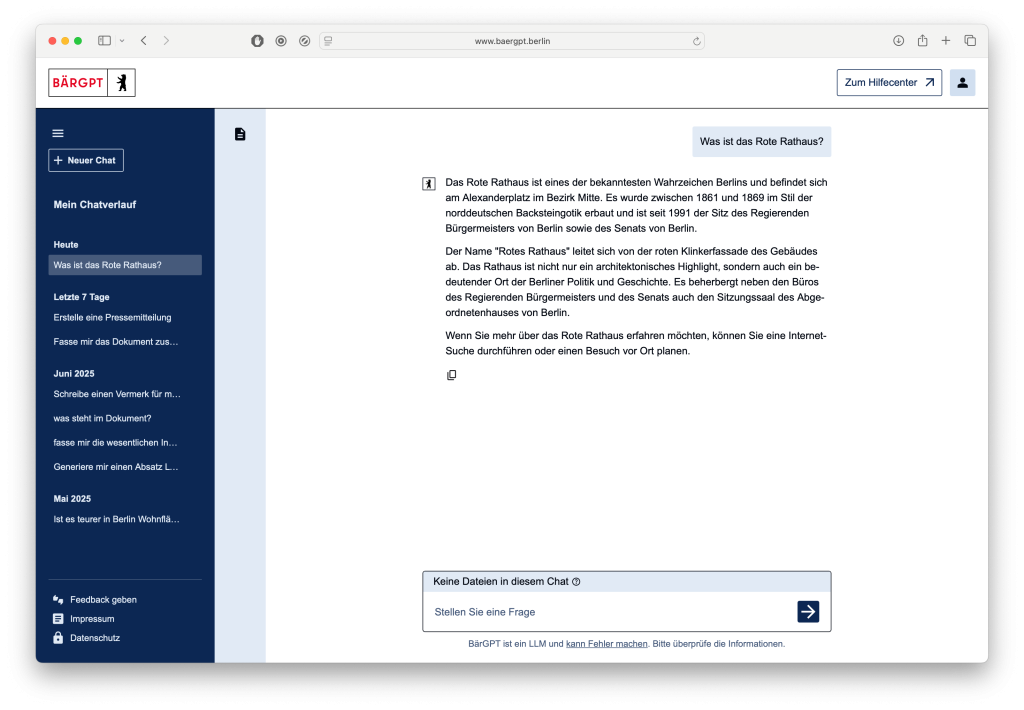
BärGPT is currently being tested with a limited number of administrative staff and is continuously being refined. We have already noticed strong interest and demand through a growing waiting list. Particularly popular is the ability to work directly with administrative documents and upload one’s own documents. Other features include transparent source indication and export functionality to Word or PDF. “We have also built up, continuously expanded, and better curated the basic knowledge base of administration so that the responses more precisely match administrative needs,” says Anna.
Regarding this base knowledge lies an important learning: such an AI assistant only works reliably if it can always access the same knowledge as its users—and thus, in the administrative context, knowledge that is not always publicly accessible. Therefore, we specifically trained BärGPT with administrative documents and built in the possibility for staff to upload their own documents into the chat, which expand the knowledge further.
Because we don’t only analyze needs but also develop prototypes ourselves, dealing with AI potentials for administration also provides us with a highly valuable learning curve technically. And since we offer all our prototypes from a defined point onward as open source, our insights are available to anyone experimenting with similar AI‑supported applications.
Off‑the‑Shelf Solutions Versus Digital Sovereignty
This naturally raises the question: does Berlin’s “bear” once again need its own AI solution? We did not ignore that many chatbot and large language model (LLM) projects already exist in the public administration context. So why test a custom prototype instead of adopting an existing solution? In scanning available tools together with administrative staff, we found functionality did not fully meet documented needs. “But the greatest advantage in in‑house development is that we truly have full control over the tech stack and individual features, which we can incrementally develop and test in close feedback with colleagues from the Berlin administration. Through in‑house development we are not dependent on providers and can test and implement new ideas quickly,” says CityLAB Director Dr. Benjamin Seibel.
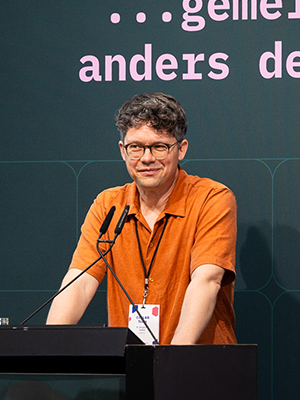
“Being able to respond quickly to new developments, maintain control over technology and data, and develop a product that really aligns with our ideas— and those of the staff— is, for us, an important aspect of the much‑discussed ‘digital sovereignty’.” Dr. Benjamin Seibel, Director CityLAB Berlin
Digital sovereignty also means that the administration can acquire the necessary knowledge itself to embed AI sensibly and self-determinedly in daily administrative work. Therefore, alongside BärGPT, we created a help page that explains first steps, effective prompt strategies, and core features. “Many staff are uncertain which applications may be used in a data‑protection‑compliant manner—especially since many offerings are not GDPR‑compliant and the handling of personal data is unclear. BärGPT offers a safe alternative, supplemented by its own help center with training material specially tailored for the administrative context,” explains Ingo on the necessity of an administration‑specific AI tool. Anna adds:
“In‑house development also allows us to explicitly control system prompt quality. Through stricter and adapted system prompt settings, responses are more precise, source‑based, and less prone to hallucinations.”

AI Can Do a Lot, But Not Everything
Anyone engaging with AI’s potentials must also grapple with its limitations. For us, it was important to understand that AI is not the solution in itself, but a functionality that can be integrated into different processes. Handing over an entire process to an AI is therefore not productive. Rather, it is many small steps where AI can be appended to offer targeted support. Thus, in our view, there cannot be a single solution that solves all current challenges in administration. Instead, what is needed is a variety of specialized offerings that develop tailored solutions using AI. And: without human guidance, it just doesn’t work, summarises our prototyping lead Ingo:
“Artificial intelligence does not replace administrative staff nor common sense. Results—whether texts or images—must always be reviewed and contextualized. AI can make communication more understandable, accessible, and sometimes more personal. However, it cannot replace human contact or individual judgment.”
– Ingo Hinterding, Team Lead Prototyping & Research Projects.
We will closely follow current developments in the field of artificial intelligence and are curious how our AI prototypes for administration will evolve. If you want to stay up to date on tools like Parla or BärGPT, feel free to visit our blog regularly or subscribe to our newsletter.