13,000 users in just two months and rising: the AI assistant BärGPT has quickly established itself as a helpful tool within the Berlin state administration. This shows how great the demand for support is, especially for routine tasks. Our CityLAB team is continuously working on further development, conducting regular user tests, and gathering feedback from users. We are interested in: Which tasks is BärGPT most frequently used for? Where is a need for improvement? And which new features are required?
Those who use BärGPT daily in their administrative work often know the tool, its strengths and weaknesses, better than we do. This is the case for Matthias Gornig from the Spandau district office and Florian Kempf from the Reinickendorf district office. Both regularly work with BärGPT and share their experiences with us here.
Up close: how administrative staff continuously co-develop BärGPT with us
Two administrative employees, two different district offices and fields of work, but at least one thing in common: both tested BärGPT at an early stage.
Matthias Gornig had already come into contact with BärGPT before its official launch. As part of a shadowing session, the CityLAB team observed his work and how he used the just developed prototype. Gornig remembers the shadowing as a positive experience because it opened up a new perspective on where AI can be used in administration to relieve workloads:
“I was able to work as usual during the shadowing. The (CityLAB) colleagues documented which steps I completed manually, and together we examined where AI could provide meaningful support. The exchange was extremely practical and helpful. I would take part again anytime. It doesn’t get more practical than that.”
Matthias Gornig, Spandau district office
In addition to shadowing, Gornig became part of the BärGPT test pool, through which the CityLAB team was able to continuously evolve the AI assistant together with administrative staff during the development phase. “It didn’t feel like testing, but like a product that already worked from the start. The system’s limitations were communicated transparently,” says Gornig. Being involved in the development process from the beginning was particularly valuable for him: “I see AI’s greatest potential in automating workflows to relieve staff and work more efficiently. It was especially helpful to understand what is happening technically behind the system and to think together about how to motivate employees to use it.”
BärGPT: Use and Development-Potential in Administration

Florian Kempf from the Reinickendorf district office also took an early look behind the scenes of BärGPT and signed up for a test-account directly after a workshop at the CityLAB Sommerkonferenz 2025. He had been waiting for the opportunity to leverage the potential of artificial intelligence in his daily work: “Since AI tools like ChatGPT became publicly available, I have tested them in various contexts. For my work, a legally compliant and high-performing AI system is particularly important, both for sensitive documents and for conceptual and creative work,” says Kempf. AI can also provide significant support as a counterpart in decision-making situations when no human sparring partner is available. According to Kempf, BärGPT fills exactly this gap:
“BärGPT enables responsible use within administration for the first time. I am convinced of its potential and see great opportunities for AI to noticeably ease everyday work and add real value.”
Florian Kempf, Reinickendorf district office
Kempf currently uses BärGPT primarily for linguistic revision and improvement of texts and emails, as a brainstorming partner, and for initial drafts of presentations and concepts. “I also regularly use the upload function to analyze, summarize, or look through my own documents for specific information. This combination of text work, generating ideas, and the analysis of documents is very valuable in everyday administrative work,” he adds.
For BärGPT to be used even more frequently in the future, Kempf sees a need for additional features such as direct internet access, voice input, or image generation. He also notes that the text output sometimes appears somewhat “stiff” or “mechanical” compared to other AI tools. He sees potential for development here. Such improvements could help establish BärGPT as a central AI tool in his daily work in the long term.
Matthias Gornig also mainly uses BärGPT for text creation and revision. As an example, he mentions the creation of a service specification: “I created a list of services for a consulting service that we had never tendered before. Through several iterations with the help of BärGPT, we developed a version ready for tender, which was then reviewed by experts of the subject. This allowed me to effectively supplement missing expertise.”
In addition to the still missing possibility of integration of BärGPT with other project management tools within administration, Gornig sees another major obstacle in developing widespread use of the tool within administration itself:
“Many employees are not even aware of important software solutions that are already available. There is a lack of transparency and visibility. There is no clear overview of which standard software is available, and the gap between the IT world and operational work is too large.”
Matthias Gornig, Spandau district office
A proposed solution from Gornig: a central software list for administration. Software should be easy to request without lengthy coordination processes. New tools need to be communicated visibly, because what is prominently displayed is also used.
How BärGPT contributes to expanding knowledge about AI-usage in administration
The successful use of BärGPT depends heavily on practice in working with AI tools. Every AI response is only as accurate as the input or prompt provided. A pre-structured working environment can help users find their way more quickly. According to Kempf, BärGPT achieves this: “The interface is intuitive and clearly designed, easy to use, and mimics other well-known AI applications. This significantly simplifies entry to the application and quickly builds confidence in using the tool.”
The accompanying help center also provides training materials. Kempf highlights the mix of formats, including videos and extensive FAQs: “In addition, the intranet offers a manual, one-pagers, and training materials, which overall provide very good support for different learning types.”
Gornig has already used the help center to improve his prompts and picked up useful techniques. His tip: “A clear definition of roles is crucial. Tone, length, and style should be specified in the prompt. A first draft is often already a big win, even if perfect results rarely come on the first attempt. It’s an iterative process, and the more precise the prompt, the better the result.”
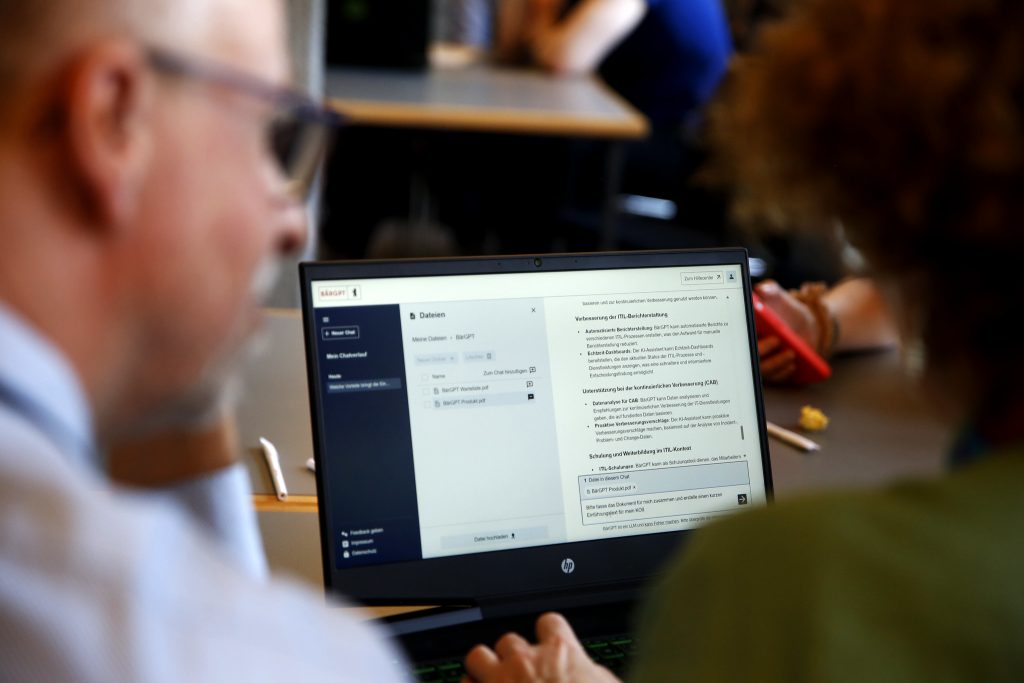
In addition to these techniques, Gornig sees predefined master prompts as a major improvement:“I don’t want to constantly have to explain which role or perspective the AI should write from. Fixed roles, master prompts, and recurring skills would make prompting much easier, because that is still a hurdle for many.”
Another challenge is the still limited trust in the reliability of AI, which is essential in the administrative context: “There is less hesitation to try AI tools, but automation is more important for us than pure text generation. Trust in generated summaries is still limited. Without reliability and performance, acceptance remains low,” says Gornig. Therefore, it is important to continuously communicate new developments and improvements.
BärGPT: why more administrative staff should use the AI tool
Despite the existing development potential, the advantages of using AI like BärGPT clearly outweigh the drawbacks for Gornig:
“Yes, I notice significant time savings. Especially for external correspondence or serial letters, the efficiency gains are enormous.”
Matthias Gornig, Spandau district office
Kempf would also recommend BärGPT to his colleagues: “The goal of building a legally compliant AI assistant for the Berlin administration is an extremely important step. At the same time, managing expectations is crucial: large, well-known tools currently offer more in some areas. However, I hope that BärGPT will continue to develop so that, in the long term, the Berlin administration can do without external competing products without losing functionality or quality.”
“What is important from my perspective: just try it out. I recommend that all colleagues test BärGPT themselves and find out whether and how it can support their daily work. I’m glad Berlin is taking this path and I’m excited to see how it develops.”
Florian Kempf, Reinickendorf district office
For Matthias Gornig, the practical, user-centred approach of BärGPT is key to its success: “There is no point in developing solutions in isolation. They have to emerge from practice. AI does not solve problems on its own, but it can solve them much faster.”
For us, the further development of our applications goes hand in hand with the needs of administrative staff. Only in this way can BärGPT truly deliver what it is needed for. That is why we are very grateful to everyone in the administration who wants to drive this change forward together with us from within.