Since 2025, the Technologiestiftung Berlin, through its CityLAB initiative, has been part of the Build4People project, which is funded by the Federal Ministry of Research, Technology and Space. After years of exploration and research into what sustainable urban development in South-East Asia might look like, the project is now in the midst of the implementation phase. Here, criteria for sustainable urban development developed in cooperation with Cambodian partners are to be put into practice, thereby initiating Phnom Penh’s so-called ‘Twin Transformation’ into a sustainable and digital city.
CityLAB Berlin is involved as a practical partner, providing support with the digitalisation aspects of the project and the development of the Phnom Penh Smart City Hub. The hub opened in December and has since become a hub for exchange right in the heart of Phnom Penh. That is why the first “Transition Manufactory” of the Build4People project took place on site at the Smart City Hub – and I was there on behalf of CityLAB.
Satellite town – sustainable and digital
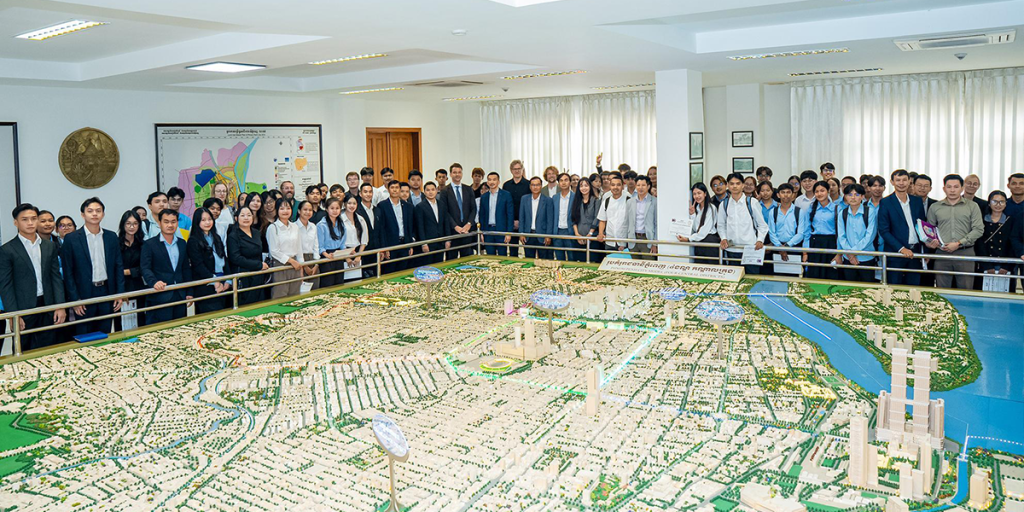
The Transition Manufactory was a week-long series of workshops and development sessions involving experts and students from various Cambodian universities. They focused on a major urban development project in Phnom Penh – the Mekong Quay Project, in which the urban development firm TMPG is creating a satellite city on a 200-hectare site opposite Phnom Penh’s city centre. Urban development in Phnom Penh is heavily influenced by the firms implementing such large-scale projects. The collaboration with TPMG was therefore a logical step towards advancing the application of the criteria developed. The aim is to ensure that the new district becomes a sustainable and digital smart city in line with the Twin Transformation.
Digitalisation was a recurring theme throughout the week in Phnom Penh and across the various work packages of the Build4People project. Digital planning tools were used to design concepts for Mekong Quay. During a workshop at the Royal University of Phnom Penh, work was carried out on further developing a citizen science app to encourage public participation. I myself was able to develop ideas for smart city projects with a group of students from the Cambodian Academy for Digital Technology. Another group worked on digital visions for the design of green and sustainable urban spaces, inspired by the work of Jan Kamensky and a visit to the CityLAB exhibition.
Grüner, kühler, bessere Luft
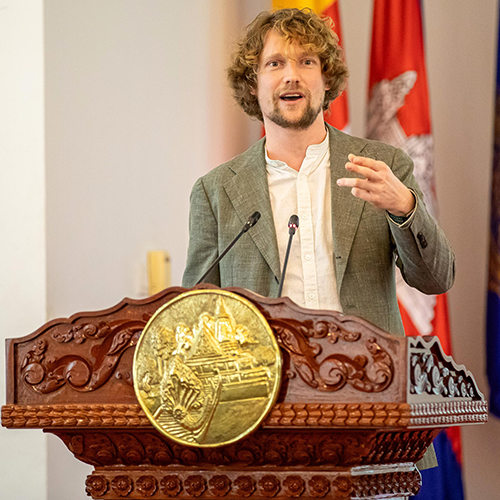
This week, as part of the project and through discussions with stakeholders, I was able to provide plenty of input and share what I had learnt in Berlin with project partners in Phnom Penh. I was repeatedly struck by just how much inspiration Phnom Penh was able to draw from Berlin: from the concept of the CityLAB as a hub for digitalisation to imaginative visions of the city and large open spaces, such as Tempelhofer Feld.
This really brought home to me how cities can learn from one another on an international level, and how certain challenges remain the same even when the underlying circumstances differ greatly. Phnom Penh, too, is grappling with how the city can become greener, how heat islands can be prevented, and how space can be better allocated for transport.
It was also important to me to expand our local network. One of our main tasks as a member of the Build4People project is to help the Phnom Penh municipal administration bring the Smart City Hub to life, drawing on the experience of CityLAB Berlin. This requires a network of stakeholders who can collaborate on this, such as the CADT, but also the local GIZ office or the Impact Hub Phnom Penh. I was delighted to have the opportunity to exchange views with His Excellency Vannak Seng; as Deputy Governor of Phnom Penh, he has been supporting the project for a long time.
The implementation phase of the Build4People project will run until summer 2027. I am very keen to see which specific proposals for Phnom Penh’s future development can be applied here. The Twin Transition will play a central role in this.